%202013%20Panayiotis%20Lipiridis),%20https://github.com/lipis/flag-icons%20--%3e%3csvg%20xmlns='http://www.w3.org/2000/svg'%20id='flag-icons-us'%20viewBox='0%200%20640%20480'%3e%3cpath%20fill='%23bd3d44'%20d='M0%200h640v480H0'/%3e%3cpath%20stroke='%23fff'%20stroke-width='37'%20d='M0%2055.3h640M0%20129h640M0%20203h640M0%20277h640M0%20351h640M0%20425h640'/%3e%3cpath%20fill='%23192f5d'%20d='M0%200h364.8v258.5H0'/%3e%3cmarker%20id='us-a'%20markerHeight='30'%20markerWidth='30'%3e%3cpath%20fill='%23fff'%20d='m14%200%209%2027L0%2010h28L5%2027z'/%3e%3c/marker%3e%3cpath%20fill='none'%20marker-mid='url(%23us-a)'%20d='m0%200%2016%2011h61%2061%2061%2061%2060L47%2037h61%2061%2060%2061L16%2063h61%2061%2061%2061%2060L47%2089h61%2061%2060%2061L16%20115h61%2061%2061%2061%2060L47%20141h61%2061%2060%2061L16%20166h61%2061%2061%2061%2060L47%20192h61%2061%2060%2061L16%20218h61%2061%2061%2061%2060z'/%3e%3c/svg%3e)
%202013%20Panayiotis%20Lipiridis),%20https://github.com/lipis/flag-icons%20--%3e%3csvg%20xmlns='http://www.w3.org/2000/svg'%20id='flag-icons-au'%20viewBox='0%200%20640%20480'%3e%3cpath%20fill='%2300008B'%20d='M0%200h640v480H0z'/%3e%3cpath%20fill='%23fff'%20d='m37.5%200%20122%2090.5L281%200h39v31l-120%2089.5%20120%2089V240h-40l-120-89.5L40.5%20240H0v-30l119.5-89L0%2032V0z'/%3e%3cpath%20fill='red'%20d='M212%20140.5%20320%20220v20l-135.5-99.5zm-92%2010%203%2017.5-96%2072H0zM320%200v1.5l-124.5%2094%201-22L295%200zM0%200l119.5%2088h-30L0%2021z'/%3e%3cpath%20fill='%23fff'%20d='M120.5%200v240h80V0zM0%2080v80h320V80z'/%3e%3cpath%20fill='red'%20d='M0%2096.5v48h320v-48zM136.5%200v240h48V0z'/%3e%3cpath%20fill='%23fff'%20d='m527%20396.7-20.5%202.6%202.2%2020.5-14.8-14.4-14.7%2014.5%202-20.5-20.5-2.4%2017.3-11.2-10.9-17.5%2019.6%206.5%206.9-19.5%207.1%2019.4%2019.5-6.7-10.7%2017.6zm-3.7-117.2%202.7-13-9.8-9%2013.2-1.5%205.5-12.1%205.5%2012.1%2013.2%201.5-9.8%209%202.7%2013-11.6-6.6zm-104.1-60-20.3%202.2%201.8%2020.3-14.4-14.5-14.8%2014.1%202.4-20.3-20.2-2.7%2017.3-10.8-10.5-17.5%2019.3%206.8L387%20178l6.7%2019.3%2019.4-6.3-10.9%2017.3%2017.1%2011.2ZM623%20186.7l-20.9%202.7%202.3%2020.9-15.1-14.7-15%2014.8%202.1-21-20.9-2.4%2017.7-11.5-11.1-17.9%2020%206.7%207-19.8%207.2%2019.8%2019.9-6.9-11%2018zm-96.1-83.5-20.7%202.3%201.9%2020.8-14.7-14.8-15.1%2014.4%202.4-20.7-20.7-2.8%2017.7-11L467%2073.5l19.7%206.9%207.3-19.5%206.8%2019.7%2019.8-6.5-11.1%2017.6zM234%20385.7l-45.8%205.4%204.6%2045.9-32.8-32.4-33%2032.2%204.9-45.9-45.8-5.8%2038.9-24.8-24-39.4%2043.6%2015%2015.8-43.4%2015.5%2043.5%2043.7-14.7-24.3%2039.2%2038.8%2025.1Z'/%3e%3c/svg%3e)
%202013%20Panayiotis%20Lipiridis),%20https://github.com/lipis/flag-icons%20--%3e%3csvg%20xmlns='http://www.w3.org/2000/svg'%20xmlns:xlink='http://www.w3.org/1999/xlink'%20id='flag-icons-nz'%20viewBox='0%200%20640%20480'%3e%3cdefs%3e%3cg%20id='nz-b'%3e%3cg%20id='nz-a'%3e%3cpath%20d='M0-.3v.5l1-.5z'/%3e%3cpath%20d='M.2.3%200-.1l1-.2z'/%3e%3c/g%3e%3cuse%20xlink:href='%23nz-a'%20transform='scale(-1%201)'/%3e%3cuse%20xlink:href='%23nz-a'%20transform='rotate(72%200%200)'/%3e%3cuse%20xlink:href='%23nz-a'%20transform='rotate(-72%200%200)'/%3e%3cuse%20xlink:href='%23nz-a'%20transform='scale(-1%201)rotate(72)'/%3e%3c/g%3e%3c/defs%3e%3cpath%20fill='%2300247d'%20fill-rule='evenodd'%20d='M0%200h640v480H0z'/%3e%3cg%20transform='translate(-111%2036.1)scale(.66825)'%3e%3cuse%20xlink:href='%23nz-b'%20width='100%25'%20height='100%25'%20fill='%23fff'%20transform='translate(900%20120)scale(45.4)'/%3e%3cuse%20xlink:href='%23nz-b'%20width='100%25'%20height='100%25'%20fill='%23cc142b'%20transform='matrix(30%200%200%2030%20900%20120)'/%3e%3c/g%3e%3cg%20transform='rotate(82%20525.2%20114.6)scale(.66825)'%3e%3cuse%20xlink:href='%23nz-b'%20width='100%25'%20height='100%25'%20fill='%23fff'%20transform='rotate(-82%20519%20-457.7)scale(40.4)'/%3e%3cuse%20xlink:href='%23nz-b'%20width='100%25'%20height='100%25'%20fill='%23cc142b'%20transform='rotate(-82%20519%20-457.7)scale(25)'/%3e%3c/g%3e%3cg%20transform='rotate(82%20525.2%20114.6)scale(.66825)'%3e%3cuse%20xlink:href='%23nz-b'%20width='100%25'%20height='100%25'%20fill='%23fff'%20transform='rotate(-82%20668.6%20-327.7)scale(45.4)'/%3e%3cuse%20xlink:href='%23nz-b'%20width='100%25'%20height='100%25'%20fill='%23cc142b'%20transform='rotate(-82%20668.6%20-327.7)scale(30)'/%3e%3c/g%3e%3cg%20transform='translate(-111%2036.1)scale(.66825)'%3e%3cuse%20xlink:href='%23nz-b'%20width='100%25'%20height='100%25'%20fill='%23fff'%20transform='translate(900%20480)scale(50.4)'/%3e%3cuse%20xlink:href='%23nz-b'%20width='100%25'%20height='100%25'%20fill='%23cc142b'%20transform='matrix(35%200%200%2035%20900%20480)'/%3e%3c/g%3e%3cpath%20fill='%23012169'%20d='M0%200h320v240H0z'/%3e%3cpath%20fill='%23fff'%20d='m37.5%200%20122%2090.5L281%200h39v31l-120%2089.5%20120%2089V240h-40l-120-89.5L40.5%20240H0v-30l119.5-89L0%2032V0z'/%3e%3cpath%20fill='%23c8102e'%20d='M212%20140.5%20320%20220v20l-135.5-99.5zm-92%2010%203%2017.5-96%2072H0zM320%200v1.5l-124.5%2094%201-22L295%200zM0%200l119.5%2088h-30L0%2021z'/%3e%3cpath%20fill='%23fff'%20d='M120.5%200v240h80V0zM0%2080v80h320V80z'/%3e%3cpath%20fill='%23c8102e'%20d='M0%2096.5v48h320v-48zM136.5%200v240h48V0z'/%3e%3c/svg%3e)
%202013%20Panayiotis%20Lipiridis),%20https://github.com/lipis/flag-icons%20--%3e%3csvg%20xmlns='http://www.w3.org/2000/svg'%20id='flag-icons-gb'%20viewBox='0%200%20640%20480'%3e%3cpath%20fill='%23012169'%20d='M0%200h640v480H0z'/%3e%3cpath%20fill='%23FFF'%20d='m75%200%20244%20181L562%200h78v62L400%20241l240%20178v61h-80L320%20301%2081%20480H0v-60l239-178L0%2064V0z'/%3e%3cpath%20fill='%23C8102E'%20d='m424%20281%20216%20159v40L369%20281zm-184%2020%206%2035L54%20480H0zM640%200v3L391%20191l2-44L590%200zM0%200l239%20176h-60L0%2042z'/%3e%3cpath%20fill='%23FFF'%20d='M241%200v480h160V0zM0%20160v160h640V160z'/%3e%3cpath%20fill='%23C8102E'%20d='M0%20193v96h640v-96zM273%200v480h96V0z'/%3e%3c/svg%3e)
Start collecting Space Marines in 40k 11e
Start a Space Marines army in 40k 11th edition: what to buy first, core units, a path to 2,000 points, and kits to skip, with live prices.
In this guide
Space Marines overview
Space Marines are the Imperium's genetically engineered super-soldiers. They are warrior-monks in power armour, organised into chapters, and each chapter has its own heraldry, traditions, and preferred way of fighting. Their story runs back to the Horus Heresy, the civil war in which half of the original Space Marine legions turned traitor. The modern Primaris marines, larger and better-equipped successors developed under Roboute Guilliman, now make up almost the whole model range.
On the table, a Space Marine army is a small number of tough, expensive soldiers rather than a horde. That makes it one of the friendliest armies to paint: you can field a full force without painting hundreds of models, and almost any colour scheme works because you can invent your own chapter.
How Space Marines play
Space Marines are generalists. Most units shoot reasonably well, fight reasonably well, and take a lot of punishment, so mistakes are rarely fatal. Most players find them forgiving to learn on for exactly that reason. The weakness is the flip side: you have fewer bodies than most opponents, so every unit you lose hurts, and you can be outnumbered on objectives.
Two rules shape almost every game:
- Oath of Moment. At the start of each of your turns you pick one enemy unit, and your army becomes much more accurate against it. In practice, you decide each turn which threat to delete and point everything at it.
- Combat Doctrines. Space Marines have three army-wide doctrines. One lets units move quickly and still shoot, one lets them move quickly and still charge into combat, and one lets them retreat from a fight and still act afterwards. You switch one on at the start of a turn, it lasts until your next turn, and normally each one can only be used once per battle. Timing them well is a big part of playing the army.
We think Space Marines suit players who like flexible, all-round armies and want to learn the core rules without being punished for every misstep. If you prefer huge model counts or a very narrow, specialised playstyle, other factions may suit you better.
Space Marines subfactions and detachments
There are two choices to make: which chapter your models belong to, and which detachment (a package of extra rules, special abilities, and upgrades you pick when you write your army list) you play.
Chapters. The six First Founding chapters each have their own named heroes and a distinct flavour:
- Ultramarines are the classic all-rounders, with a deep bench of characters led by Marneus Calgar.
- White Scars favour speed, bikes, and hit-and-run attacks.
- Raven Guard focus on stealth, infiltration, and striking from unexpected angles.
- Imperial Fists are defensive specialists who like heavy firepower and holding ground.
- Iron Hands lean on armour, vehicles, and Dreadnoughts.
- Salamanders love flamers and melta weapons; their hero Vulkan He'stan makes those weapons hit harder against a chosen target.
You can also paint your own successor chapter and use any of these rules, borrowing their characters as stand-ins. The divergent chapters, Blood Angels, Dark Angels, Space Wolves, and Black Templars, have their own supplements and unique units. They're a bigger commitment: a Dark Angels army, for example, can't include units from other chapters.
Detachments. The Gladius Task Force is the generalist choice and lets you use one of your Combat Doctrines a second time in a game. That suits a mixed collection, and we think it's the right place for a new player to start. Themed detachments such as Assault Brethren or Ironclad Champions reward building around one type of unit, such as close-combat infantry or heavy armour. Pick one of those only once you know which models you enjoy.
If you're unsure, buy generic Space Marine kits, which work for every chapter, and decide on a theme later.
What to buy first
The Warhammer 40,000 Armageddon 11th Edition Launch Box is the cheapest sensible way in. It contains a mixed Space Marine force with characters, battleline infantry, jump infantry, and light vehicle support, plus an Ork army, the rules, and terrain. The best deal is to split it with a friend who wants the Orks. Even if you keep the whole box, it works out cheaper per model than buying the same kits separately. One caution: the models are monopose (each one is built in a single fixed pose) and have fixed weapons, so buying a second copy just gives you duplicates of the same squads. Buy it once.
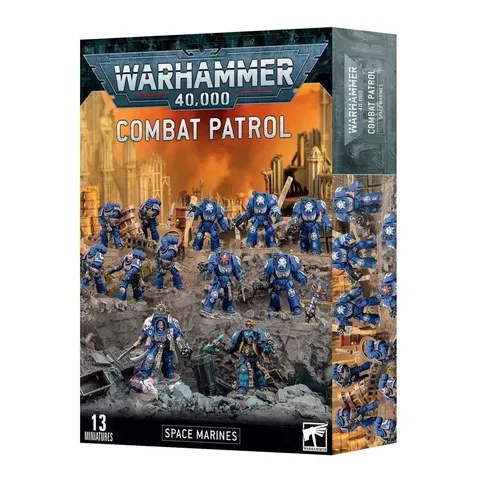
If you want a smaller, Space Marines-only box, Combat Patrol: Space Marines is built around Terminators and flame-armed Infernus Marines with Terminator characters to lead them. It plays straight out of the box in the smaller Combat Patrol format, and every kit in it stays useful later.
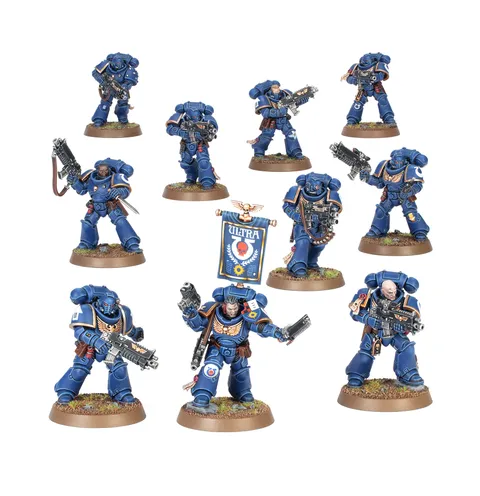
If you'd rather start with a single kit to see whether you like painting the army, a box of Intercessors is the safe pick. Every list uses them.
| Product | Cheapest | Saving | |
|---|---|---|---|
 | Combat Patrol: Space Marines | $164.99Cape Fear Collectibles | $3.01 |
 | Intercessor Squad | $57.37Wargame Portal | $10.13 |
Prices checked November 9, 2026. Prices exclude shipping and sales tax.
We'd skip Combat Patrol: Dark Angels unless you specifically want Dark Angels. Its Gravis-armoured Captain doesn't come with the heavy infantry he works best with, and Dark Angels can't mix in units from other chapters. The same goes for the Blood Angels, Space Wolves, and Black Templars Combat Patrols: they're good boxes, but only if you've committed to that chapter.
Cost to start
This is the Armageddon launch box on its own, at the cheapest tracked store, against RRP. If you split it with an Ork player, your share is roughly half.
Core units
Intercessors are your battleline, the reliable troops that hold objectives. They're tough for infantry, carry solid rifles, and are good at standing on a point while the rest of the army does the damage. Every Space Marine list wants at least one squad. Buy them as Intercessor Squad.
Captain. Your general. A Captain makes the unit he joins (a "Leader" attaches to a squad and fights as part of it) noticeably better, and if he's your warlord he earns you extra Command Points. Those are the currency you spend on special tactics during the game. Look for the Space Marine Captain or the Captain with Relic Shield.
Lieutenant. A cheaper support character who joins a squad alongside another leader and makes that squad more lethal. The Space Marines Lieutenant kit is a good second character. The Phobos-armoured Lieutenant with Combi-weapon works differently: he works alone, sets up far forward, and is hard for the enemy to target from a distance, which makes him an excellent objective-grabber.
Eradicators are three heavily armoured marines with melta rifles, short-ranged guns that are brutal against tanks and monsters. Most starter forces lack heavy anti-tank weapons, and Eradicators fix that for a modest outlay. Buy the Eradicator Squad.
Terminators are elite veterans in the heaviest armour Space Marines wear. They can teleport onto the battlefield partway through the game (Deep Strike) and are very hard to shift from an objective. Buy the Terminator Squad.
Redemptor Dreadnought. A big walking war machine with heavy guns and a crushing fist. It's a durable centrepiece and a good test of whether you enjoy vehicles before you buy more of them. Buy the Redemptor Dreadnought.
Infiltrators are cheap scouts that set up well forward before the game starts. They're ideal for grabbing distant objectives and blocking enemy units that arrive mid-game. The Incursor Squad / Infiltrator Squad kit builds either Infiltrators or their sibling unit, Incursors.
Intercessor Squad
5 models: 85 pts · 10 models: 170 pts
- M
- 6"
- T
- 5
- Sv
- 3+
- W
- 2
- Ld
- 6+
- OC
- 2
| Ranged | Rng | A | BS | S | AP | D |
|---|---|---|---|---|---|---|
| Bolt Pistol | 12" | 1 | 3+ | 5 | -1 | 1 |
| Bolt Rifle - Focused Fire | 24" | 1 | 3+ | 6 | -1 | 2 |
| Bolt Rifle - Saturation | 24" | 2 | 3+ | 5 | -1 | 1 |
| Melee | Rng | A | WS | S | AP | D |
|---|---|---|---|---|---|---|
| Knives and Fists | – | 3 | 3+ | 5 | 0 | 1 |
| Chainsword | – | 5 | 3+ | 5 | -1 | 1 |
| Power Fist | – | 3 | 3+ | 8 | -2 | 2 |
Captain
90 pts
- M
- 6"
- T
- 5
- Sv
- 3+
- W
- 5
- Ld
- 6+
- OC
- 1
- Inv
- 4+
| Ranged | Rng | A | BS | S | AP | D |
|---|---|---|---|---|---|---|
| Heavy Bolt Pistol | 18" | 1 | 2+ | 5 | -1 | 1 |
| Master-crafted Bolter | 24" | 2 | 2+ | 5 | -1 | 2 |
| Neo-volkite Pistol | 12" | 1 | 2+ | 5 | 0 | 2 |
| Melee | Rng | A | WS | S | AP | D |
|---|---|---|---|---|---|---|
| Master-crafted Power Weapon | – | 6 | 2+ | 6 | -2 | 2 |
| Power Fist | – | 5 | 2+ | 8 | -2 | 2 |
Lieutenant
50 pts
- M
- 6"
- T
- 5
- Sv
- 3+
- W
- 4
- Ld
- 6+
- OC
- 1
| Ranged | Rng | A | BS | S | AP | D |
|---|---|---|---|---|---|---|
| Bolt Pistol | 12" | 1 | 2+ | 5 | -1 | 1 |
| Master-crafted Bolter | 24" | 2 | 2+ | 5 | -1 | 2 |
| Heavy Bolt Pistol | 18" | 1 | 2+ | 5 | -1 | 1 |
| Melee | Rng | A | WS | S | AP | D |
|---|---|---|---|---|---|---|
| Ceramite Fists | – | 5 | 2+ | 5 | 0 | 1 |
| Master-crafted Power Weapon | – | 5 | 2+ | 6 | -2 | 2 |
| Power Fist | – | 4 | 2+ | 8 | -2 | 2 |
Lieutenant with Combi-weapon
85 pts
- M
- 8"
- T
- 4
- Sv
- 3+
- W
- 4
- Ld
- 6+
- OC
- 1
| Ranged | Rng | A | BS | S | AP | D |
|---|---|---|---|---|---|---|
| Combi-weapon - Bolter | 24" | 2 | 2+ | 5 | -1 | 2 |
| Combi-weapon - Flamer | 12" | 3 | - | 5 | -1 | 1 |
| Melee | Rng | A | WS | S | AP | D |
|---|---|---|---|---|---|---|
| Paired Combat Blades | – | 6 | 2+ | 5 | -1 | 1 |
Eradicator Squad with Melta Rifles
3 models: 100 pts · 6 models: 200 pts
- M
- 5"
- T
- 6
- Sv
- 3+
- W
- 3
- Ld
- 6+
- OC
- 1
| Ranged | Rng | A | BS | S | AP | D |
|---|---|---|---|---|---|---|
| Bolt Pistol | 12" | 1 | 3+ | 5 | -1 | 1 |
| Melta Rifle | 18" | 1 | 3+ | 10 | -3 | D3+2 |
| Melta Rifle - Hunter | 18" | 1 | 2+ | 12 | -3 | D3+2 |
| Melee | Rng | A | WS | S | AP | D |
|---|---|---|---|---|---|---|
| Ceramite Fists | – | 3 | 3+ | 5 | 0 | 1 |
Terminator Squad
5 models: 190 pts · 10 models: 380 pts
- M
- 5"
- T
- 6
- Sv
- 2+
- W
- 3
- Ld
- 6+
- OC
- 1
- Inv
- 4+
| Ranged | Rng | A | BS | S | AP | D |
|---|---|---|---|---|---|---|
| Storm Bolter | 24" | 2 | 3+ | 5 | -1 | 1 |
| Assault Cannon | 24" | 6 | 3+ | 6 | -2 | 1 |
| Cyclone Missile Launcher - Frag | 36" | 8 | 3+ | 4 | -1 | 1 |
| Melee | Rng | A | WS | S | AP | D |
|---|---|---|---|---|---|---|
| Power Fist | – | 3 | 3+ | 8 | -2 | 2 |
| Chainfist - Standard | – | 2 | 4+ | 8 | -2 | 2 |
| Chainfist - Hunter | – | 3 | 3+ | 12 | -2 | 3 |
Redemptor Dreadnought
170 pts
- M
- 8"
- T
- 10
- Sv
- 2+
- W
- 12
- Ld
- 6+
- OC
- 4
| Ranged | Rng | A | BS | S | AP | D |
|---|---|---|---|---|---|---|
| Fragstorm Grenade Launchers | 18" | 6 | 3+ | 4 | -1 | 1 |
| Heavy Flamer | 12" | 3 | - | 5 | -1 | 1 |
| Heavy Onslaught Gatling Cannon | 24" | 12 | 3+ | 6 | -1 | 1 |
| Melee | Rng | A | WS | S | AP | D |
|---|---|---|---|---|---|---|
| Redemptor Fist | – | 5 | 3+ | 12 | -3 | D3+3 |
Infiltrator Squad
5 models: 85 pts · 10 models: 150 pts
- M
- 8"
- T
- 4
- Sv
- 3+
- W
- 2
- Ld
- 6+
- OC
- 1
| Ranged | Rng | A | BS | S | AP | D |
|---|---|---|---|---|---|---|
| Bolt Pistol | 12" | 1 | 3+ | 5 | -1 | 1 |
| Marksman Bolt Carbine | 24" | 2 | 3+ | 5 | -1 | 1 |
| Melee | Rng | A | WS | S | AP | D |
|---|---|---|---|---|---|---|
| Ceramite Fists | – | 3 | 3+ | 5 | 0 | 1 |
Points as of November 8, 2026
Expanding your Space Marines army
A common mistake is buying a pile of single characters early on. They look great but add little to the army's points. Most players find it better to grow in squads and decide on characters once you know which units you like.
Towards 1,000 points. Start from a Captain, a Lieutenant, and a full squad of Intercessors. Then add the pieces that cover the starter's gaps: Eradicators and a Ballistus Dreadnought for long- and short-range anti-tank, a Redemptor as your durable walker, Terminators to anchor an objective, and Space Marine Scouts as a cheap unit that deploys forward. That gives you something that can fight tanks, hold the middle of the table, and score the missions.
| Captain | 90 |
| Lieutenant | 50 |
| Intercessor Squad (10 models) | 170 |
| Eradicator Squad with Melta Rifles (3 models) | 100 |
| Redemptor Dreadnought | 170 |
| Terminator Squad (5 models) | 190 |
| Scout Squad (5 models) | 65 |
| Ballistus Dreadnought | 150 |
| Total | 985 pts |
|---|
Points as of November 8, 2026
Towards 2,000 points, the standard size for matched play (balanced games using points limits and set missions), group your purchases by job:
- Anti-armour fire. The Gladiator Lancer is a dedicated tank-hunter, and the same box also builds the Reaper and Valiant. The Repulsor Executioner is a heavy gun tank and a natural centrepiece.
- Mobile scoring. Outriders on bikes and Assault Intercessors with Jump Packs move fast, grab far-off objectives, and counter-attack anything that wanders too close. A second set of Infiltrators adds more forward pressure.
- Durable damage. A full ten-model Hellblaster Squad with your Lieutenant attached is a serious plasma threat, and Bladeguard Veterans, shield-carrying melee veterans, hold the centre line.
| Captain | 90 |
| Lieutenant | 50 |
| Intercessor Squad (10 models) | 170 |
| Eradicator Squad with Melta Rifles (3 models) | 100 |
| Redemptor Dreadnought | 170 |
| Terminator Squad (5 models) | 190 |
| Scout Squad (5 models) | 65 |
| Ballistus Dreadnought | 150 |
| Gladiator Lancer | 160 |
| Hellblaster Squad (10 models) | 230 |
| Outrider Squad (3 models) | 80 |
| Assault Intercessors With Jump Packs (5 models) | 95 |
| Repulsor Executioner | 260 |
| Infiltrator Squad (5 models) | 85 |
| Bladeguard Veteran Squad (3 models) | 90 |
| Total | 1985 pts |
|---|
Points as of November 8, 2026
For value, we think Terminators and Hellblasters are among the best boxes in the range, because each kit puts a lot of points on the table. Small three-model elite kits and single characters give the least. If you'd rather run a tank-heavy force, swap the jump troops for a Repulsor, an Impulsor transport, and a Techmarine to repair your vehicles. If you'd rather go fast and aggressive, lean into jump packs, Bladeguard, and Drop Pods. Independent stores, local clubs, and second-hand sellers can all save you real money on these kits, and the tables above show where.
Space Marines kits to avoid
None of these are bad models, but each comes with a risk worth knowing about.
- Older-style infantry boxes. The classic Tactical Squad, Assault Squad, and Devastator Squad build the smaller, pre-Primaris marines. None of them appears in our current unit data. Intercessors, Assault Intercessors, and Desolation or Hellblaster squads cover the same roles with current rules.
- Ageing vehicle kits. The Rhino and Land Raider are still playable, but they're old sculpts, and the video guides expect replacements during this edition. If you want a transport now, the Impulsor or Repulsor is the safer buy.
- Fortifications, flyers, and super-heavies. The Hammerfall Bunker, the Stormhawk Interceptor, and big resin pieces such as the Thunderhawk Gunship are expensive and get little attention in matched play. Models that move into Legends (retired rules kept for casual games) are usually not allowed at events.
- Pricey single characters. Many named-hero blisters cost a lot for one model. A Captain or Chaplain converted from a spare Bladeguard body does the same job for far less.
Painting Space Marines
Start with a primer spray in your chapter's main colour, for example blue for Ultramarines, red for Blood Angels, or a grey or white base for White Scars. That way the first coat does most of the work. A simple two-colour scheme (main armour plus one contrasting trim colour) looks sharp at table distance and is quick to repeat across a whole army.
Test your scheme on a single Intercessor before you commit. Batch-paint the rest in groups of five: base the armour, add metals and the trim colour, then give everything a wash. A dark wash such as Nuln Oil suits blue, black, and grey armour, and a brown wash such as Agrax Earthshade warms up red, yellow, and green. A three-step approach of basecoat, wash, and one highlight on the sharpest edges gets you a smart army without full box-art detail. Save the careful work for vehicles and characters once your first squads are done.
Further watching
These videos cover the army in more depth. Auspex Tactics and Vanguard Tactics go through the codex and chapter rules, Poorhammer plans collections on a budget, and TacticalTortoise offers buying advice and sample lists.
- Starting Space Marines in 2025 | Buying Guide, Tactics & Sample Lists | Getting Started in 40k · TacticalTortoise 40k
- Get Started with Space Marines in Warhammer 40k · Vanguard Tactics
- A Noob's Guide to Collecting Space Marines · Poorhammer
- How to Start a Space Marine Army in Warhammer 40K 11th Edition – Beginner Guide to Start Collecting · Auspex Tactics
Unit data from Wahapedia.